
Industrial Dust Filter Cartridge Guide: Media, Pleat Design, ΔP & Service Life
When an industrial dust collector runs smoothly, nobody notices it. But when the filter cartridges are wrong, the symptoms show up fast—high differential pressure (ΔP), unstable airflow, visible emissions, frequent pulsing, and rising compressed-air cost.
This guide is built for plant engineers, dust-collector OEMs, distributors, and procurement teams who want a repeatable way to specify the right cartridge—globally, across different dust types and operating conditions. We’ll cover media selection, pleat geometry, sealing design, and service-life strategy, plus a clear checklist you can send to your supplier.
If you want to review cartridge options first, start here:
XFHC industrial dust filter cartridges (internal link): https://xfmesh.com/dust-filter-element-manufacturer-xfhc-industrial-dust-filter-cartridges/
All products (internal link): https://xfmesh.com/products/
1) Define the Dust First (Because Dust Controls Everything)
A filter cartridge is not “one size fits all.” The same cartridge that works in a woodworking shop can fail quickly in metal grinding or chemical powder.
Collect these inputs before you select media:
Dust behavior
- Fine vs. coarse dust: fine dust tends to embed and drive ΔP up faster
- Abrasive dust: accelerates media wear and pleat damage
- Sticky/hygroscopic dust: bridges pleats, clogs quickly, hates moisture
- Conductive/static-sensitive dust: may require anti-static solutions
- Oil mist / moisture: can create “mud cake” and permanent blinding
Operating conditions
- temperature (steady + peak)
- humidity and condensation risk (dew point)
- airflow rate and air-to-cloth ratio
- pulse-jet settings (pressure, frequency, valve quality)
Safety and compliance (combustible dust)
If combustible dust is possible, filtration is part of a broader safety system. As a general reference, see OSHA’s combustible dust resources (external link):
https://www.osha.gov/combustible-dust
2) Media Selection: The Fastest Way to Improve Performance
Think of filter media as the “engine” of the cartridge. Structure matters, but media determines capture efficiency, cleanability, and life.
Common media options (what they’re best at)
Polyester (PET)
- Good general-purpose industrial media
- Strong pleats, stable structure
- Better moisture resistance than basic cellulose
Cellulose / cellulose blends
- Cost-effective for dry, non-sticky dust
- Typically shorter life in humid or abrasive environments
PTFE membrane (surface filtration)
- Excellent for fine dust and stricter emission targets
- Dust cake stays on the surface → easier pulse cleaning → more stable ΔP
- Strong option for “high efficiency + long life” requirements
Nanofiber-coated media
- Designed to capture fine particles earlier on the surface
- Helps lower initial ΔP while maintaining good efficiency
- Often chosen when customers want “premium performance” without full PTFE membrane cost
Anti-static media
- Helps reduce static charge build-up for certain powder applications
- Important note: anti-static media is not a full combustible-dust protection plan—treat it as one layer within a compliant system
Oil & water repellent treatments
- Useful when oil mist or humidity is unavoidable
- Reduces permanent blinding in real-world shop conditions
If your process involves high temperature, corrosion, or you need a metal solution, review stainless steel filter elements (internal link):
https://xfmesh.com/stainless-steel-filter-element-xfhc-metal-mesh-sintered-filters/
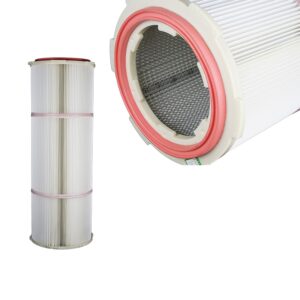
3) Pleat Geometry: Why “More Area” Can Fail Faster
Many buyers focus on surface area. In practice, pleat spacing and pleat stability often matter more than raw area.
What goes wrong
- Pleats too tight → dust bridges between pleats → early blockage → ΔP spikes
- Weak pleat support → deformation under pulse cleaning → poor dust release → early failure
- Poor airflow distribution → uneven loading → localized wear and leaks
What you want instead
- consistent pleat spacing that releases dust under pulsing
- stable inner/outer support structure
- robust seam construction designed for repeated pulse stress
In other words: a cartridge must be designed for cleanability, not only initial efficiency.
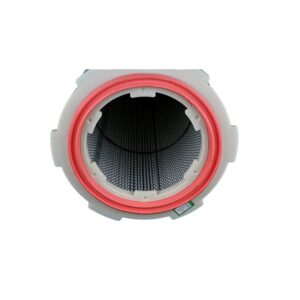
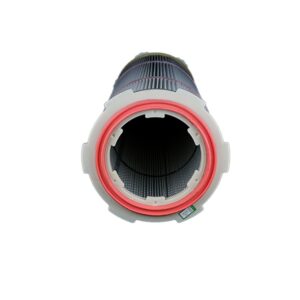
4) Sealing & End Caps: The Hidden Difference Between “Looks OK” and “Performs OEM-Grade”
Two cartridges with identical dimensions can perform completely differently because of:
- end cap bonding quality (adhesive + curing + interface design)
- gasket design (material, compression set resistance)
- fitment tolerance to the collector mounting plate
- leak paths caused by micro gaps or deformation
A small seal issue can create bypass leakage. Bypass means:
- emissions rise even with “new filters”
- the system runs dirtier than expected
- maintenance costs increase because ΔP behavior becomes unstable
5) Differential Pressure (ΔP): Your Best KPI for Cost, Life, and Stability
If you track only one metric, track ΔP. A better cartridge specification typically delivers:
- lower initial ΔP
- slower ΔP increase over time
- stable pulsing behavior with less compressed air
Quick diagnosis by ΔP pattern
- ΔP rises rapidly (days/weeks): dust embedding, pleat bridging, moisture, or media not suitable
- ΔP stays low but emissions increase: leakage, damaged media, or poor sealing
- ΔP is always high: airflow too high, wrong cartridge size, or pulse settings need optimization
6) Service-Life Strategy: Extend Life Without Overpaying
Long life does not always mean “most expensive media.” The best results come from a matched system:
- choose media based on dust and humidity
- design pleats for release under pulse cleaning
- ensure sealing and bonding quality
- control moisture and reduce unnecessary pulsing
A practical, global approach is to standardize two or three “performance tiers”:
- Standard: stable performance for general dust
- Premium: PTFE membrane or nanofiber for fine dust / stricter emissions
- Specialty: anti-static, oil/water repellent, or custom dimensions for unique processes
This tier approach makes procurement easier and improves consistency across plants.
7) RFQ Checklist: What to Send Your Supplier (So You Get It Right the First Time)
Send these items to reduce back-and-forth and avoid wrong shipments:
- dust type + photos (and MSDS if available)
- operating temperature and humidity
- collector model or cartridge dimensions (OD/ID/length)
- pulse-jet conditions (pressure, frequency)
- current ΔP range and pain points
- target outcome: lower ΔP, longer life, higher efficiency, anti-static, etc.
For inquiries and recommendations, contact:
XFHC Air Filter (Anping Xiangfang Filter Material Co., Ltd.)
Contact page (internal link): https://xfmesh.com/contact-us/
WhatsApp: +86 19932383113
Email: qin@xfmesh.com
About us (internal link): https://xfmesh.com/air-filter-3/
Follow XFHC for updates (external links):
X: https://x.com/XFFilter
Facebook: https://www.facebook.com/profile.php?id=61582195179658
Instagram: https://www.instagram.com/xffilterqin/
Pinterest: https://www.pinterest.com/XFHCFilter/
TikTok: https://tiktok.com/xfhcfilter
FAQ (for SEO)
Q1: Which media is best for fine industrial dust?
PTFE membrane and nanofiber media are commonly chosen for fine dust because they support surface filtration and easier pulse cleaning.
Q2: Why do cartridges clog quickly even after replacement?
Typical causes include tight pleat spacing, sticky dust, moisture/condensation, or media that allows deep dust embedding.
Q3: Do anti-static cartridges solve combustible dust risks?
Anti-static media can help reduce charge build-up, but combustible dust compliance requires a full risk assessment and proper safety design beyond filter media alone.
industrial dust filter cartridge, dust collector filter cartridge, industrial dust filter element, pleated cartridge filter, pulse jet filter cartridge, PTFE membrane filter cartridge, nanofiber filter media, antistatic dust filter cartridge, dust collector differential pressure, cartridge filter replacement, dust filtration efficiency, filter media selection